- Blog
- March 10, 2026
Talent Strategies for Navigating Evolving Regulatory Landscapes with AI-Augmented Compliance Tools

- Blog
- March 10, 2026
Talent Strategies for Navigating Evolving Regulatory Landscapes with AI-Augmented Compliance Tools
Organizations today operate in regulatory environments that are becoming more complex and dynamic than ever before. Industries such as financial services, life sciences, healthcare, and manufacturing face continuous changes in compliance requirements, data privacy rules, and risk management expectations. Traditional compliance models, which rely heavily on manual monitoring and periodic reporting, are increasingly unable to keep pace with the speed of modern digital operations.
To address this challenge, many enterprises are turning to AI-Augmented Compliance Tools that enable real-time monitoring, intelligent risk detection, and automated regulatory reporting. While these technologies provide powerful capabilities, their effectiveness depends heavily on the talent behind them. Organizations must rethink how they build compliance teams, combining regulatory expertise with technology and data skills. Developing the right talent strategy is becoming essential for navigating evolving regulatory landscapes successfully.
The Shift Toward AI-Augmented Compliance Tools
Regulatory compliance has traditionally been viewed as a reactive function focused on ensuring policies are followed and documentation is maintained. However, as digital transformation accelerates, compliance must evolve into a proactive and technology-enabled discipline.
AI-augmented compliance platforms are helping organizations monitor transactions, analyze regulatory updates, and identify risks more quickly than manual processes allow. Machine learning algorithms can detect unusual activity patterns, flag potential violations, and provide insights that support faster decision-making. Automated reporting tools also reduce administrative burden while improving accuracy and consistency.
These capabilities allow compliance teams to move beyond manual oversight toward continuous monitoring and predictive risk management. Instead of responding to issues after they occur, organizations can anticipate potential compliance challenges and address them proactively.
Why Talent Strategies Must Evolve
While technology is transforming compliance operations, it is also redefining the capabilities required within governance and risk teams. Traditional compliance roles were primarily focused on regulatory interpretation, documentation, and audit preparation. Today, the landscape demands a broader skill set that combines regulatory knowledge with technology and analytics expertise.
Compliance professionals must now work closely with data scientists, AI engineers, and IT architects to design and manage intelligent compliance platforms. They must also understand how automated systems generate insights and ensure that these systems operate in accordance with regulatory standards.
This shift creates a growing demand for hybrid professionals who understand both regulatory frameworks and modern technology environments. Organizations that fail to develop these capabilities risk falling behind as compliance functions become increasingly data-driven and automated.
New Roles Emerging in AI-Driven Compliance Environments
As enterprises adopt AI-powered compliance platforms, new roles are emerging to support these advanced systems.
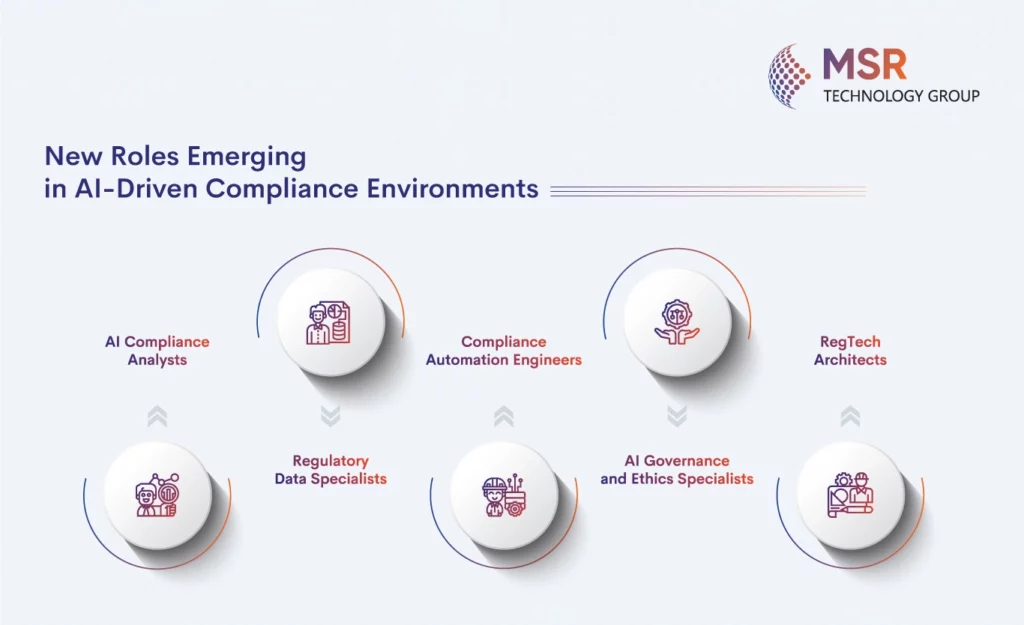
- AI Compliance Analysts: These professionals interpret insights generated by AI systems and ensure that automated findings align with regulatory expectations and internal governance policies.
- Regulatory Data Specialists: They manage the data pipelines that feed compliance platforms, ensuring that information used for monitoring and reporting remains accurate, complete, and auditable.
- Compliance Automation Engineers: These specialists design automated workflows that integrate regulatory checks directly into operational processes and digital platforms.
- AI Governance and Ethics Specialists: Their role is to ensure that AI-driven compliance tools operate transparently, ethically, and within regulatory guidelines.
- RegTech Architects: These professionals design enterprise-scale compliance platforms that combine AI, automation, and data governance to support continuous monitoring and reporting.
Together, these roles reflect the growing convergence of compliance expertise and advanced technology capabilities.
Key Skills Needed for the Future Compliance Workforce
As AI becomes more integrated into compliance operations, organizations must prioritize the development of new capabilities across their teams.
Key skills include:
- Understanding how AI and machine learning support regulatory monitoring and risk detection
- Strong knowledge of data governance, privacy regulations, and audit frameworks
- Experience with automation and analytics tools used in compliance platforms
- Ability to translate regulatory requirements into technology-driven controls and workflows
- Collaboration across compliance, IT, legal, and data teams
Developing these hybrid capabilities can be challenging because demand for AI and regulatory expertise is growing rapidly across industries.
Overcoming Talent Challenges in Compliance Transformation
Building teams capable of managing AI-driven compliance environments presents several challenges. One of the most significant issues is the shortage of professionals who possess both regulatory knowledge and advanced technology expertise.
Traditional compliance professionals may lack experience with AI systems and data platforms, while technical experts may not fully understand regulatory frameworks. Bridging this gap requires significant investment in training, cross-functional collaboration, and workforce development.
Retention is another challenge. As demand for AI and compliance expertise grows, organizations face increasing competition for skilled professionals. In addition, compliance transformation initiatives often require rapid scaling of talent during technology implementations or regulatory changes.
To address these challenges, many organizations are adopting more flexible talent strategies. This includes combining internal compliance teams with specialized external expertise and investing in continuous upskilling programs that help professionals adapt to evolving regulatory technologies.
Building Future-Ready Compliance Organizations
The future of regulatory compliance lies in combining intelligent technologies with skilled professionals who can manage them effectively. AI-Augmented Compliance Tools enable organizations to monitor risks, automate reporting, and maintain compliance in increasingly complex digital environments. To fully realize these benefits, enterprises must build teams that combine regulatory expertise with data and AI capabilities, enabling more proactive and scalable compliance operations.
MSR Technology Group supports this transformation by providing specialized professionals with expertise in AI, regulatory technology, data governance, and compliance automation. Through flexible talent strategies and industry expertise, MTG helps organizations strengthen compliance capabilities while accelerating the adoption of intelligent compliance platforms.